
Bayanat Labs dataset template and the 20-point Arabic dataset card checklist
One release standard for new Bayanat Labs datasets: a bilingual card, a licence on every record, a provenance ledger, a claims ledger and a takedown route. The checklist is free for anyone to use.
What the template is
The Bayanat Labs dataset template (Bayanat-Labs/dataset-template) is the repository template that new Bayanat Labs open datasets are generated from, starting with template version 0.1.0. Earlier Bayanat Labs releases predate it. It is built with copier, so a repository made from it can pull later versions of the standard with one command.
A repository generated from the template contains:
- A bilingual card:
README.mdin English with the Hugging Face metadata header and an Arabic summary, plus a full Arabic card inREADME.ar.md. - Rights files:
LICENSEfor our contribution,LICENSE-sources.mdandLICENSES/for the upstream licences, and asource_licensefield on every record. - Ledgers:
PROVENANCE.jsonl(where each item came from, when, under what terms) andCLAIMS.md(every comparative claim, with its evidence and date). - Packaging:
CITATION.cff,croissant.json,MANIFEST.json,SHA256SUMSandCHANGELOG.md. - A pipeline skeleton: a pipeline package under
src/with one module per stage, andqa/,rebuild/andeval/folders, so the numbers in the card come from scripts. - Two checks: a card linter (
bl-card-lint) and a release-gate checker (bl-gates) that fail a release when a required file, card section, licence or claim record is missing.
Licences: the template code is Apache-2.0; the template text and this checklist are CC BY 4.0. If you reuse them, please credit "Template by Bayanat Labs (bayanatlabs.com/open/standard)".
The 20-point Arabic dataset card checklist
Use this list before you publish an Arabic dataset on Hugging Face. Bayanat Labs checks each new release built from its dataset template (v0.1.0 on) against it with the bl-card-lint tool; each point names the rules that enforce it. The list is free to reuse under CC BY 4.0.
Under each point: the rules that enforce it in Bayanat Labs releases, the check we used for cards by other publishers in the audit below, and how many of the 100 audited cards met it.
C01. Two cards, one of them in Arabic
Publish an English card (README.md) and a full Arabic card (README.ar.md) with the same sections in the same order. Put a short Arabic summary at the top of README.md, inside a right-to-left block, with a link to the Arabic card.
- Enforced in Bayanat Labs releases by: R009, R010.
- Audit check for other publishers' cards: An Arabic card file (such as README.ar.md) in the repository, or a description in Arabic in the README.
- Met by 0 of 100 audited cards.
C02. Complete Hub metadata
Fill the YAML front matter: pretty_name, licence tags, language, task categories, size category, tags and one entry per config with its data files.
- Enforced in Bayanat Labs releases by: R001, R006.
- Audit check for other publishers' cards: The metadata header has pretty_name, a licence tag, language, task_categories and size_categories.
- Met by 49 of 100 audited cards.
C03. Arabic varieties tagged, labels traced
List ar in language and every dialect as a BCP-47 tag (ar-SA, ar-EG, ar-MA, or a variety code such as afb for Gulf Arabic) in language_details. Every dialect label in the data says where it came from: source metadata, author intent, automatic inference or native review.
- Enforced in Bayanat Labs releases by: R005, R019.
- Audit check for other publishers' cards: The metadata names at least one Arabic variety as a code or tag (for example ar-SA, arz, ary_Arab).
- Met by 27 of 100 audited cards.
C04. Publisher named correctly, next step clear
Spell the publisher's name the same way everywhere, end both cards with the footer and the hub page link, and link the matching paid product family for buyers who need more.
- Enforced in Bayanat Labs releases by: R007, R015, R016.
- Audit check for other publishers' cards: The card names a contact or a home page for the publisher. (The Bayanat Labs footer and paid-family link apply only to our own releases.)
- Met by 48 of 100 audited cards.
C05. Every required section, in a fixed order
Keep all required sections (FineWeb's eleven, the five Bayanat Labs sections and the additions) with their markers, and leave no placeholder behind.
- Enforced in Bayanat Labs releases by: R008.
- Audit check for other publishers' cards: Summary, structure, creation, limitations or personal data, licence and citation all have content, and no template placeholder is left.
- Met by 7 of 100 audited cards.
C06. One licence per config, from the matrix
Give each config exactly one licence that the release matrix allows for its content. Never use a non-commercial, no-derivatives or custom licence on your own work, and never Apache or MIT on data.
- Enforced in Bayanat Labs releases by: R002, R003.
- Audit check for other publishers' cards: Every licence tag is one the release matrix allows for data (no NC, ND, Apache or MIT, no unknown), with no more tags than configs.
- Met by 37 of 100 audited cards.
C07. Share-alike content kept apart
Keep Wikipedia-derived text in its own CC BY-SA 4.0 config with the page URL and revision ID on every record, and keep ODbL data in its own config.
- Enforced in Bayanat Labs releases by: R004.
- Audit check for other publishers' cards: Applies to share-alike, ODbL or Wikipedia-derived sets: share-alike licences are not mixed with others in one config, and Wikipedia-derived records carry a URL and a revision field.
- Met by 9 of 30 audited cards (30 of the 100 datasets are in scope).
C08. Licence on every record
Carry source_license and source_license_url on every record, and say in the card that the underlying content is not licensed by the publisher when it comes from third parties.
- Enforced in Bayanat Labs releases by: R018, R019.
- Audit check for other publishers' cards: The records have a licence field (dataset viewer feature names).
- Met by 2 of 100 audited cards.
C09. Raw text beside normalised text
Keep the original text untouched in text_raw next to text_norm, and name the normalisation policy and its version in the creation section.
- Enforced in Bayanat Labs releases by: R020.
- Audit check for other publishers' cards: Applies to text sets: the records have a raw-text field and a normalised or cleaned text field.
- Met by 0 of 91 audited cards (91 of the 100 datasets are in scope).
C10. Numbers from scripts
Write every count, share and score in the card from a script that reads the released files, and keep it inside a generated block.
- Enforced in Bayanat Labs releases by: R013.
- Audit check: Not checked, because whether a card's numbers come from scripts cannot be seen from outside.
C11. No superlative without a ledger entry
Write “largest”, “first” or “only” (أكبر، أول، الوحيد) only in the exact wording of an approved claim that was re-verified in the last 30 days, with its unit, licence class, date and incumbent.
- Enforced in Bayanat Labs releases by: R011, R012.
- Audit check for other publishers' cards: No superlative claim about the data, such as “the largest ... dataset” or “the first ... corpus”, and no superlative in a title (cards by others have no claims ledger to back one).
- Met by 95 of 100 audited cards.
C12. Provenance per source and per record
List every source with its URL, licence, legal basis, date checked and rights signals (robots.txt, TDMRep, Content-Signal), and ship a per-record provenance ledger.
- Enforced in Bayanat Labs releases by: R017.
- Audit check for other publishers' cards: The card names its sources and the records carry a source URL field.
- Met by 13 of 100 audited cards.
C13. People in the data, and the PDPL
Say whether identifiable people appear. If they do, state the collection basis, how Saudi and UAE personal-data law was applied, that data was anonymised before upload, and the PII audit result.
- Enforced in Bayanat Labs releases by: R022.
- Audit check for other publishers' cards: The card says whether personal data appears and how it was handled.
- Met by 16 of 100 audited cards.
C14. No minors
Do not include children's speech or images of children, and say so in both cards. Leave out face sets and other biometric data too, except identifiable sign-language video collected under explicit biometric consent.
- Enforced in Bayanat Labs releases by: R023.
- Audit check for other publishers' cards: The card states that children's data (such as speech or images) is excluded or absent.
- Met by 0 of 100 audited cards.
C15. Uses, out-of-scope uses and separate rights
State intended uses and out-of-scope uses, and give the rights for model training, display and quotation, redistribution and synthetic voice as four separate rows.
- Enforced in Bayanat Labs releases by: R021.
- Audit check for other publishers' cards: The card states both intended uses and out-of-scope uses.
- Met by 4 of 100 audited cards.
C16. Speech released responsibly
For speech, ask users not to clone voices, release non-consented audio at 16 kHz, and never use platform auto-captions as transcripts.
- Enforced in Bayanat Labs releases by: R025, R026.
- Audit check for other publishers' cards: Applies to speech sets: the card asks users not to clone or impersonate voices.
- Met by 0 of 19 audited cards (19 of the 100 datasets are in scope).
C17. A public takedown route
Give an e-mail address and a takedown page, remove items within 30 days, and act on platform, personal-data and child-safety requests within 24 hours.
- Enforced in Bayanat Labs releases by: R014.
- Audit check for other publishers' cards: The card tells people how to ask for content or data to be removed.
- Met by 4 of 100 audited cards.
C18. EU AI Act training-data summary
Add a short section that model providers can reuse: modality and size, collection window, top source domains, opt-out protocols honoured, crawler identity and the takedown route.
- Enforced in Bayanat Labs releases by: R024.
- Audit check for other publishers' cards: The card has an EU AI Act section or a training-data summary (Article 53).
- Met by 0 of 100 audited cards.
C19. Open access, protected test sets
Do not gate the release. For evaluation sets, add a canary GUID to the card and the data, keep a hidden test split and ship task files for common evaluation harnesses.
- Enforced in Bayanat Labs releases by: R027, R028.
- Audit check for other publishers' cards: The dataset is not gated; for evaluation sets, the card also carries a canary string (canary GUID).
- Met by 89 of 100 audited cards.
C20. Release files complete and verifiable
Ship the licence texts, a citation file, a file manifest, SHA-256 checksums and a validated Croissant file, and check that every hash matches.
- Enforced in Bayanat Labs releases by: R029, R030.
- Audit check for other publishers' cards: The repository has a licence file, CITATION.cff, a manifest, checksums and a Croissant file (the Hub's Croissant endpoint counts).
- Met by 0 of 100 audited cards.
The checklist draws on the Hugging Face dataset card guidance, Datasheets for Datasets and the section structure of the FineWeb card. It adds what Arabic releases need: an Arabic card (C01), tagged Arabic varieties (C03), Saudi and UAE personal-data handling (C13) and a public takedown route (C17).
What we found: an audit of Arabic-tagged dataset cards
On 15 October 2026 we checked the cards of the 100 most-downloaded Hugging Face datasets tagged Arabic (ar) against the 19 points of this checklist that can be checked from outside: the median card met 5 of them (a point that does not apply counts as met), the highest score was 11, and no card met any of these 6 points: C01, C09, C14, C16, C18 and C20.
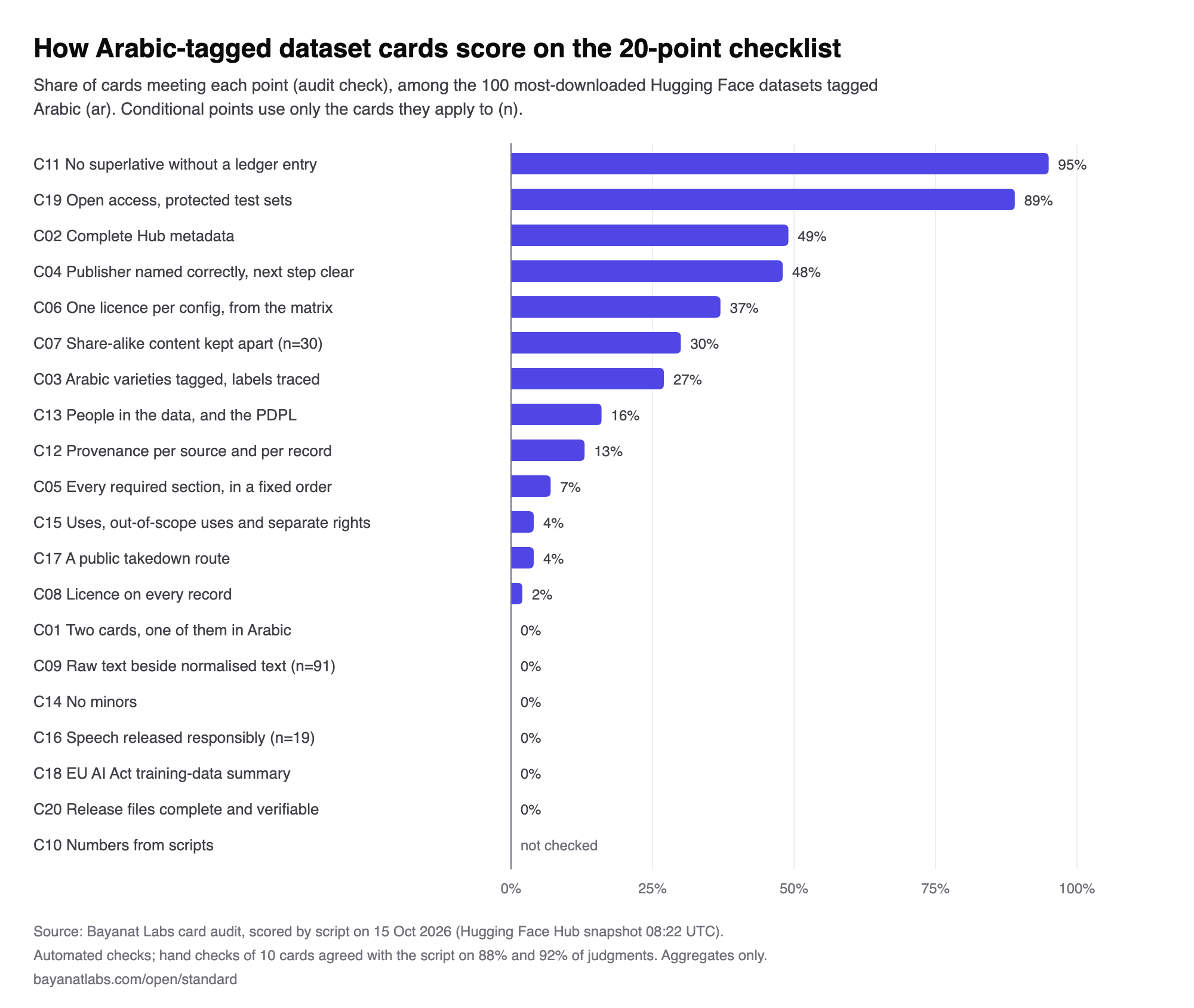
Method. We listed the 100 datasets with the language tag ar that had the most downloads on the Hugging Face Hub in the previous 30 days, using the Hub API without signing in (08:22 UTC, 15 October 2026). For each dataset we read the README card at that revision, the repository's top-level file list and the field names shown by the dataset viewer. The checklist was written for Bayanat Labs releases, so for cards by other publishers we checked the core of each point (the "audit check" under each point); C10 cannot be checked from outside. Points that apply only to some datasets (C07, C09 and C16) count only those datasets. Where the evidence was missing, for example field names for datasets the viewer cannot read, the point counts as not met. The text rules were refined on 10 cards and then compared with a separate reading of 10 other randomly drawn cards, made before the script output was seen: they agreed on 176 of 200 judgments for the general card rules (88%) and on 46 of 50 for the checklist-specific rules (92%). In 18 of the 24 general disagreements the script found a rule not met that the separate reading found met.
Limits. Several points ask for things that only a release built to this standard is likely to have (for example C14, C18 and C20), so low numbers there show the distance from this standard, not the general quality of a card. Most of the 100 datasets are multilingual collections that include Arabic among many languages; 17 are Arabic-focused (every language tag is Arabic, or there are at most two tags and one is Arabic), and their median was 5 of 19. Download counts change daily, so the ranking is a snapshot. The rules read only the card, the file list and the field names, not linked papers or websites.
We publish aggregate numbers only. We do not rate or name individual datasets.
How to use the template
- Install copier:
pip install "copier==9.18.0"(orpipx install copier). - Generate a repository from the released template and answer the questions (name, modality, licence per config, sources):
copier copy --vcs-ref v0.1.0 gh:Bayanat-Labs/dataset-template my-arabic-dataset - Fill in the card and the ledgers, then install the release kit from the template repository and run the checks from the new repository:
cd my-arabic-dataset
pip install "bayanatlabs-release-kit @ git+https://github.com/Bayanat-Labs/dataset-template@v0.1.0#subdirectory=kit/bayanatlabs-release-kit"
make lint gates
make lintrunsbl-card-lint hf --answers .copier-answers.ymlon the Hugging Face folder;make gatesrunsbl-gates --gh-repo . --hf-repo hf --job <job folder> --out qa/reports/gates.json(the job folder is$BL_JOB_DIR, or the repository itself). - When the standard changes, update your repository with
copier update.
You can also use the checklist on its own: copy the 20 points into your own review, or into a pull request on an existing dataset card.
Cite as
Bayanat Labs (2026). Bayanat Labs dataset template and 20-point Arabic dataset card checklist, version 0.1.0. https://www.bayanatlabs.com/open/standard
@misc{bayanatlabs_dataset_template_2026,
  title  = {Bayanat Labs dataset template and 20-point Arabic dataset card checklist},
  author = {{Bayanat Labs}},
  year   = {2026},
  note   = {Version 0.1.0; card audit of 15 October 2026},
  url    = {https://www.bayanatlabs.com/open/standard}
}
Corrections and questions: hello@bayanatlabs.com.